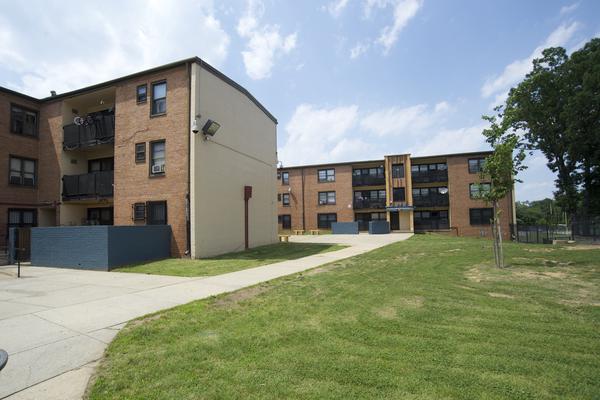
Truck tires sink into the potholes on their way up the street, plodding along to their destinations under the dim streetlights. Pedestrians travel down the concrete barriers placed in between the lanes, unfazed by the loud clomping further ripping apart the divots. Liquor stores and tobacco shops sit at the corners, their doors open to fight the humid summer air. The heat is evident on the backs of the young men standing in the McDonald’s parking lot, sweat staining their white undershirts. They passed around a phone, listening to a video and breaking into a disarming smile at its content. A few of the boys sank back onto a black sedan, laughing heartedly and slumping onto the hood. An older man reclined in the driver’s seat and shared a gap-toothed cackle with the group. A block west, a group of young white men and women stumble out of an indoor mini golf bar, with one tripping haphazardly into a pair of parked cars.
This isn’t St. Louis.
The air is suffocating and thick in the summer heat. The street was filled with young professionals in full sweat as they walked from their parked cars on Benning Road towards the bars on H Street. Brittanie sat at her living room window and shook her head. They too comfortable.
“Close them blindszzz,” a muffled voice yelled out; Brit turned and saw her mother standing behind the couch, puffing a menthol cigarette. “It’szz…too much light in here.”
“Always out there. Damn traaaaiii…don’t know why they…they even put that out there.” Brit’s mother leaned back onto the couch, nearly dropping the lit cigarette. “Fuckin’ white folk alway wanna be somewhere they ain’t ‘posed to be.”
CiCi, Brit’s sister, walked out of the bedroom and looked down at her mother. Her eyes immediately cut toward the window where Brit still stood closing the blinds. “She out?”
This isn’t St. Louis.
The street was abuzz. A couple walked hand in hand, a corded set of earbuds split between them. Brit squinted from her second-floor window at the phone and saw motion from a video. She couldn’t make out the details, but she could see the young woman move toward the man slightly as her head bobbed. She didn’t glance up at the project building once; he stared straight ahead, also blissfully unaware of the residents’ conditions and circumstances above them.
The City welcomes those with the means to leave. There wasn’t much for those that sauntered back to their apartments, stuck here. Not Benning Road, anyway. Those young men in the McDonald’s parking lot were swatted away before prime bar hours. They left in every direction, slinking back into the various quandaries The City chose to ignore. While H Street indulged in all of the nonsense a tabbed credit card could afford, the rest of Northeast Washington, D.C. strove to live.
The swelling weekend traffic is nonexistent come Monday morning. On the walk up to Union Station, Brit routinely saw pieces of uneaten cookies, used bar napkins, and the returning foot soldiers previously ushered away by bar security. Northeast seemed a newly minted saint apologetic for its previous sins, and its City workers feverishly scrambled to cleanse its misgivings. Two men in black suits and briefcases shoved past her in the station entranceway, absentmindedly sipping from paper cups. Their thoughtlessness was nothing new. Brit continued behind them toward the escalators leading to the Metro train platform beneath the building. Government workers. Consultants, maybe. It was a daily routine. On her morning walk to work, dozens of men and women spilled out from the MARC commuter train and hastily walked down to the Metro Station. It was much the same in the evening, with many of the same faces instead going up the escalator toward the regional train, whisking them back into their waiting Maryland suburbs. Sometimes she would look at the gates full of people – eager to return home and forget D.C. – and long for that feeling again. A transactional relationship. For Washington, D.C. to be a destination, and not a net in which she found herself caught.
It’s not St. Louis.
The potholes become deeper and more pronounced as the street winds eastbound. The streetlights shine with varying levels of luminance, as does what sits beneath them. The dark shadow of RFK Stadium looms menacingly in the distance. There are no suits strolling aimlessly about. There is no promise of advancement. Self-importance does not lie in a title. The sights have not changed here. It is suspended in time, as the future hinges mostly on getting through today.
Brit slung her bag over a chair and walked past the dining room table into the living room. The television was on and obscenely loud; she could hear it echoing off the walls of the apartment building stairway as she walked up. Some commentators were going on about something as the screen showed football players in drenched compression shorts catching passes from a machine zipping balls in their direction. No one else was in the room, and she looked down the narrow hallway toward her mother’s room. Darren was here.
The borders of The City are as invisible as the residents bound by them. Every day, upwards of a million workers cross its boundaries from the neighboring Virginia and Maryland suburbs, focused solely on career advancement. Maybe a drink or five after work. When the sun begins to lower under the cityscape, outbound trains and cars race for those borders, their self-worth again fulfilled. The City’s swollen center is again empty.
Nothing like St. Louis.
Brit sat at the window looking down on the street. Two kids in white collared shirts and khakis walked below. The late August sun glared offensively into one of the young boy’s eyes and he glared up toward the window as if some bored soul was reflecting aluminum foil in his direction. Brit grinned slightly. She remembered being one of those children walking home with their friends, talking about a place outside of here. A loud shriek from the closed bedroom door brought her back to the present.
*****
The Maryland border sat two miles away, but for many inhabitants of the Benning Terrace apartment complex, it was an entire day’s worth of effort. North Carolina might as well be on the opposite coast. The smiles and shouts from Brit’s neighbors confirmed as much. “My girl goin’ to AT&T!” came a voice from somewhere in the crowded terrace. “Buuuuug!” exclaimed another. Brit held her acceptance letter above her head victoriously. A charcoal grill placed in a parking spot cooked burgers in celebration. An old man they called Blue – though Brit never knew why – sipped a Michelob while he cooked. A sign that read ‘Congratulations Bug’ was sprawled across the low fence surrounding the grassy area in front of her building. What should have been a moment of pride felt hollow, as a noticeable absence loomed over the party. Brit sat in a plastic lawn chair, greeting her well-wishers with an empty smile.
Greensboro is cool, but it ain’t St. Louis.
*****
“THEN GET THE…FUCK OUT THEN!” Brit’s mother swung the door open, and Darren stumbled backwards into the hallway. He fastened his pants, panting heavily and raising his right hand to feel for the doorframe. Brit’s mother wasn’t visible in the hallway, but her voice carried out into the living room and, surely, through the thin walls of the small apartment.
Darren gathered his balance and walked around Brit to collect his things. She turned towards him expressionless as he stooped over, grabbed his shoes, and exited silently. There was a thump after the door closed, presumably from Darren leaning back on the door to slip into his shoes in the safety of the stairway. Brit turned back to the window as her mother entered the room yelling at the closed door.
Empty McDonald’s wrappers and cups are pushed aside when the cars travel down the street. Their drivers pay no mind to the garbage and continue driving along swiftly toward Baltimore-Washington Parkway. The workday is over. The City served its purpose, and the urban sprawl becomes smaller and more distant in the rearview mirrors. They cross the bridges en masse, as if they were escaping the clutches of an imminent threat, its reach only extending to those invisible borders.
Brit continued staring out the window at the bustle of the people on the street below her. She wondered why everyone walked so fast. What urgency was there to continue to do the same thing? She wondered what their lives were like. What motivated them to get up and repeat this mundane existence? She obsessed over these questions, perhaps trying to derive some meaning for her own life as well. She stared at the setting sun for a few moments. It too made its exit to some far-off land. Somewhere beyond D.C. What was it like to be bound to nothing but your own desire? To be unfettered by demand and oblivious to obligation? What was it like to not feel trapped?
*****
The genuine pride emanating from the attendees stuck in Brit’s mind vividly. The smiles were radiant, not at all clouded by jealousy. What these people felt about Brit’s accomplishment was pure. A scholarship to go to school in another state. To be somewhere else for four years. Maybe forever. It was the fulfilment of many dashed hopes and ambitions, and the vicarious shared existence that allowed them to believe in something more than this. That the world was not as far away as it seemed. That those borders were open to traverse freely. That it was possible. That they could move about as unincumbered as those businessmen and women in Union Station.
Missouri Avenue was only about six miles to the west, and with it, Brit’s father. Maybe the bus ride was a bit too far, and waiting at the stop would leave his beard moist with perspiration. Maybe his wife and other daughter were more worthy of his attention. Those imagined motivations, Brit had long been able to justify and compartmentalize. But she knew. He was selfish and disinterested in her life. It was normal and familiar at this point. She used to trek over to Northwest on occasion once she was old enough to traverse The City, but that stopped once she realized the effort was one-sided and – quite frankly – unfair. But even still. This was a huge achievement that no one on either side of her family had come close to realizing. It stung. There were no new tears to cry or burgeoning insecurities to harbor, but it pricked at her pride all the same. A stack of congratulatory greeting cards were piled on a table next to the grill; none were from him. She was certain.
*****
Being back in D.C. played devious games with her ego. A year ago, she sat in that plastic chair, enjoying the fruits of so much labor. A reward then promised to supplant youthful whims now tangible. Standing out in a school full of standouts finally paying a dividend that had seemed uncertain entering her senior year of high school. It was a lifetime of sacrifice lost in the matter of a schoolyear. Finally enjoying a sliver of independence and autonomy, only to lose her scholarship. She now had to place her faith in the Department of Education, a faith that had yet to be reciprocated. It was a feeling of despair that was not afforded her. As her dreams sat in deferral, she couldn’t help but feel the glimmer of hope that was St. Louis vanishing with the setting sun.
As a grade-schooler, Brit talked almost obsessively about going to St. Louis. It was right down the street, she had thought. Right there on Missouri Avenue. She would buy a big house with some pretty purple flowers adorning the walkway. There would be a fenced in swing set with monkey bars attached at the end. Maybe even a little doghouse for BeBe and CeCe, named after characters from her favorite cartoon, The Proud Family. She would be successful and rich and happy and everyone would love her. Mommy would be so proud. And maybe Daddy would be, too. Maybe being this close to him would make him stop by. He could even make her popcorn and hot dogs while they watched the Redskins play on Sundays. Linda, his wife, would bring her leftover cookies from the middle school in Prince George’s County she taught at, just as she did for Bethany. She could even walk to their house after work! There would be pans of spaghetti and garlic bread on the table. She would tell Daddy about her day and its frustrations and tease Bethany for being a timid, quirky little sister. She Googled St. Louis in fifth grade and it looked so comely. There was an arch overlooking a long river. Behind it were buildings she couldn’t recall seeing in D.C.; an unexplored part of The City robust with boundless opportunity. She imagined the streets weren’t worn down and littered with plastic bottles and cigarette butts. No wonder Daddy never came to Benning Road. I wouldn’t either, she had thought.
Her childhood dream of St. Louis was jaded shortly after her eleventh birthday. She learned the Gateway Arch, the structure of which she envisioned so endearingly, was placed in Missouri as part of America’s westward expansion. she was disheartened to learn that this place of promise and contentment sat hundreds of miles away in the state of Missouri. The place her father had found happiness was simply another area of D.C., not terribly unlike her little section of Northeast. Still, she sat almost daily at the window, staring off into the sunset. She wondered what her father was doing, and if he ever had a passing thought about his eldest daughter. It was just six miles away. Some days she stared intently, as if to will Missouri Avenue into her focus through the buildings amongst her.
Brit’s mother, now calm from the brown drink in her hand, turned the television volume to full blast again, stirring Brit from her dusky dalliance with the street below. “Ain’t nothing out there girl, I told you that before. Now close them damn blinds, Bug. I can’t see the TV.” Brit sighed, twisted the tilt wand, and her view slowly became obscured by the white plastic.
 The Fly Hobo and His World of Oddities